


Vesper ran, laughing, her six-year-old energy endless. The cape fluttered just beyond her fingertips as she chased Nadir around the trampoline. He was faster than usual today, excitement making his little legs move quicker. She had let him free their cousins from the “prison”, the bench next to the bird fountain, and now it was her turn to catch him.
She was supposed to let him win sometimes. That’s what her parents said. She was the older sibling, and she liked seeing him smile, especially today, his fourth birthday.
The day had been perfect. They started with their favourite movie, snuggled together on the couch. Then they packed their bags for a few days at Grand’Ma Rose’s house. Vesper loved Grand’Ma Rose. She told the best jokes, smelled like flowers, and had a big garden where they could play for hours. Before heading there, they stopped at the bakery to pick out a cake. Nadir chose a velvet cake. Vesper would have preferred chocolate, but Mama reminded her that it wasn’t her birthday.
They picked up their cousins, and Jean carried a funny-looking bag with Nadir’s present inside. When they finally arrived at Grand’Ma Rose’s, they smothered her with hugs and big smooches on both cheeks. She laughed, loud and warm.
Lunch was fries and ham. Grand’Ma Rose made the best fries, thanks to a robot her friends had given her. They were all as old as she was and always talked about people and places Vesper didn’t know. But Grand’Ma was the loudest every time, which made it fun to watch.
After the cake, Nadir opened his gifts. Grand’Ma gave him a robot, and their cousins got him a t-shirt from his favourite cartoon. Usually, Papa gave the family presents, but he had been staying home lately. So, this time, Vesper got to hand Nadir the gift she had picked out herself. It was a Zorro costume, complete with a mask, hat, and cape. She had chosen it carefully in the big store.
It was warm and sunny, perfect for running outside. Nadir wore the mask and cape but left the sword inside. It wasn’t practical for chasing the others. Grand’Ma Rose poured them soda in plastic cups and made coffee for herself and Mama. Vesper had tried coffee once, but it was terrible. Still, she liked dipping sugar cubes in her mother’s cup, watching the liquid climb up before popping the cube in her mouth. It made the sweetness taste strange and interesting. Mama said it was due to capillary action, what a strange word too.
Sweat trickled down her cheek. She had caught Nadir and their cousins again. And now it was Jean’s turn to be “it.” As she counted behind the tree, Vesper darted inside for a drink.
Her mother and Grand’Ma were still talking at the table. Mama no longer looked happy. The smile she had worn when they arrived was gone.
“I can’t reach Tobias at all…” she whispered.
Tobias. Papa’s name.
Before they left, Vesper had sneaked past her mother and tiptoed into the living room. “Are you coming with us?” she had asked.
“I’ll see you soon,” he had said. But there was no truth in it. He had barely moved from his spot in days, just sitting there, staring at the lamp.
Now, Mama and Grand’Ma were saying complicated things about him. Vesper didn’t want to hear anymore. She slipped back outside.
That night, while Mama bathed Nadir, Vesper played in their shared room. She glanced out the window, looking up at the night sky. The stars scattered across the darkness, but something felt off.
There were fewer than before.
One, two, three… maybe more were missing.
It was strange.
Grand’Ma Rose came to tuck her in. “Grand’Ma, why are the stars disappearing?” Vesper asked.
Grand’Ma smiled, smoothing back her hair. “It’s probably just the lights from the house, ma chérie.”
Vesper stared out the window again. She wasn’t so sure.
“What does it mean when something vanishes?” she asked. “Mama said Papa is vanishing.”
Grand’Ma’s smile faltered, just for a second.
“It means he’s not feeling well in his head right now. He’s not all here with us. But he needs time to get better.”
Vesper hesitated. “Do people come back when they vanish?”
Grand’Ma didn’t answer right away.
“I don’t know,” she finally said, pressing a kiss to Vesper’s forehead. “Try not to think about it, ma douce. We’ll call him tomorrow.”
The scent of flowers lingered as Grand’Ma left the room.
In the quiet darkness, Vesper kept her eyes on the sky. The stars continued to disappear.
Two days later, so did her father.
And if even adults didn’t have answers, maybe sometimes there were none at all.
“You do remember the stars?” Radimir murmured, his fingers caressed Vesper’s side.
“Yes, as small dots in the sky,” she responded, shivering slightly with her head resting on his pillow.
“Sky?” he asked, curious.
She checked her phone as it buzzed on the nightstand, then immediately declined the call.
“I’m not sure I remember what that was, but I think it was big,” she said, rolling onto her back and stretching her arms wide.
“That big?” Radimir mocked, wrinkling his nose playfully.
“Bigger,” she teased back, pressing a kiss against his bicep. “But size doesn’t matter… that much.”
He chuckled but then sighed. “You always care about things disappearing. Stars, sky, old places…” His tone was light, dismissive.
Vesper tensed. “Because it does matter,” she said, turning to face him fully. “Doesn’t it bother you? That things just go? That no one even notices?”
Radimir tilted his head, considering her. Then, instead of answering, he grabbed her still-buzzing phone and sat up dramatically.
“Hello! You’ve reached the personal assistant of Miss Vesper,” he said in an exaggerated, professional voice.
“No, don’t…” She reached for the phone, but he held it away, grinning.
“Ah, yes, urgent matters, I assume? Oh. Her brother?” He glanced at her, teasing but gentle.
She groaned, flopping onto her back. “I know… That’s… ugh, just give it.”
He handed it over with an amused look. She hesitated a second before putting it to her ear.
She listened. Her expression hardened. Her brother’s voice was firm, frustrated. Words like Mum, stroke, hospital cut through. She barely said anything before he snapped, “You weren’t here.”
Something in her cracked, but she covered it with coldness. “Why does it matter?” she said flatly. “There won’t be anything left anyway.”
The call ended.
So did the last insect of existence.
She exhaled sharply, staring at the ceiling.
Radimir watched her in silence. He was annoying most of the time. But the rest of the time… he was pleasant.
“Are you sure you’re okay?” he asked, searching her face.
“Yes,” she said, a little too quickly. Then, with a sharp grin, she rolled over him. She seized his wrists, her touch both hungry and angry. “And things will only get better.”
He didn’t refuse her lead. For a few more minutes they were, together, real, tangible, solid, undeniable.
He was okay for now.
Like cigarettes, the next one would probably be more or less the same.
“You left a hickey so bad I had to wear turtlenecks for weeks,” he said, mock-accusatory hovering his fork. “My mother never understood my sudden passion for them.”
Vesper snorted. “Gosh, we were… young.”
“Oh, because now we’re mummies?” he teased.
“I mean, it was a long time ago.”
Radimir let the pause hover. “Years.”
She exhaled. “I’m sorry.”
“For?”
“For leaving. Without a note. That was probably harsh.”
“It was devastating.”
Silence.
“But time passed. And time is… time.”
Vesper made a face. “That’s deep.”
Radimir smirked. “Well, look at us. One month as lab partners, and we’re already two civilised adults joking about our past wild sex life over lunch in a restaurant.”
“It was wild.”
“Oh, and I’m gay now, thanks to you.”
“Really?!”
“Not at all. But you should have seen your face.” He laughed before softening. “But I do believe in friendship. And reconciliation.”
Vesper gave a small nod. “We need to believe and remember. That’s quite literally our job.”
“Speaking of which, we’ve got reports to review.”
“About?”
“Birds. Sparrows and crows.”
“Crows ring a bell. I thought they disappeared months ago.”
“No, that was ravens.”
“If you say so…” Radimir glanced at the other diners, at the dull horizon stretching beyond them. “There won’t be any birds soon.”
“If only we knew how many there were before.” She sighed. “Anyway, we got the funding you suggested. But they want ‘corrections.’”
“I can guess what kind.”
“We’ll review them this afternoon. Worst case, we eat instant noodles for a few more months while looking for overseas funding.”
“If there are overseas lands next month…”
They both fell quiet. This field was never a money-maker. But if the politicians could stop debating their usefulness and just untie the bloody leash…
Vesper had a ridiculous thought. Could sparrows or crows get hickeys? The report was, as usual, scant on details. Did they even have necks? Blood? Who could remember?
Still, it had been a pleasant lunch. The awkwardness between them had faded faster than anything else in their field. They had moved on without realizing it. No grudges. Just two hearts that had initially loved each other the wrong way.
And, like everything else, time passed.
Vesper exhaled, watching the world blur into shades of grey. The air wasn’t cold, but she still shivered as she lit a cigarette.
“You haven’t quit?” Radimir asked, judgmental.
“Multiple times. But I always come back.” She took a drag. “Landscapes evaporate. People take flights to nowhere. We forget our own history, and still, I can’t quit smoking. I, like people, just keep going.”
Radimir studied her. “You’ve changed.”
“Not really.” She exhaled slowly. “I feel more trapped. Nothing changes. Day after day, it’s the same cycle: work, eat, sleep. I expected things to mean more because everything is fading. But even meaning seems to be vanishing.”
“You’ve changed,” he repeated, softer this time.
“If you say so.”
A scream cut through their conversation. Across the lawn, a child ran with a dog, her mother chasing after them, exasperated but laughing. Vesper sometimes envied those who chose the parental path. It was too late for her now, more or less. She was okay with it.
Mostly.
The child’s laughter rang out again, bright and unbothered. The mother, finally giving in, let out a breathless laugh, swept up in the moment.
Maybe that was it.
The child didn’t care that the horizon was gone. They didn’t need answers. They just laughed.
And for a fleeting second, Vesper wondered if meaning wasn’t in knowing, but in choosing to live as if things mattered anyway.
Live. Laugh. Love.
Vesper crushed her cigarette under her boot. The streets were calm, quieter than they should be. Without cars, without movement, the city felt more like a monument than a place where people lived. It wasn’t really a problem. There wasn’t much beyond the city anymore. A couple of acres of land, maybe, but nothing that mattered. People only remembered snippets of what came before. Forests, oceans, mountains, words drained of weight, dreams passed down by those who still tried to believe.
Radimir placed a hand on her shoulder.
“It’s time,” he said.
She exhaled, rolling her shoulders back, adjusting her blazer. Inside the funeral home, Nadir was already there, standing beside his wife, their baby cradled in her arms. Their mother’s photo hung above the coffin. Maybe there were other guests too.
The funeral was small. They always were. There weren’t enough people left to fill the room with sorrow, no processions winding, no useless, forced condolences. Just a handful of figures in dark coats, standing in the centre of a building that once had a name.
An administrator spoke. The words were kind, practiced, generic. The wind moved between them, whispering through the empty spaces. A prayer, maybe. A song once sung in another time.
Someone said the name of the dead.
It was Nadir.
There was grief, though. Real and heavy. A touch on the shoulder, a breath held too long, a tear wiped away before it could fall. The world may have crumbled into silence, but loss still lingered. And for a moment, something once mattered.
Then —
“You weren’t there for her life,” Nadir said, voice quiet but sharp. “You have no right to be here.”
Vesper turned to him, her face blank, unreadable. “I have to be here. She was my mother.”
“It doesn’t look like it.”
“You can’t change that. Don’t be a child, Nadir.”
“I’m not a child anymore. Thanks to you.”
Vesper clenched her jaw. “Always the fault of others, huh?”
“She had a stroke on my birthday!” Nadir’s voice broke, shaking with years of buried anger. “I was still a teenager. I needed you! I needed my sister!”
“You hung up on me.”
“Because you asked me: ‘Why does it matter?’” He scoffed, shaking his head. « That’s why! Because of this,” he snapped, his fist slamming against their mother’s coffin. “Because she’s gone, and the last memories I have of the three of us are just… fights!”
“She crumbled after Dad left. Like the rest of the world.”
“She changed because she lost her husband.”
“I lost a father.”
“So did I! And my sister! You ran away, Vesper. You left as soon as you could.”
“You can’t blame me for leaving the nest.”
“But I can blame you for never coming back.”
“I couldn’t,” she said, voice quieter now. “I had to live.”
Radimir stepped between them, pushing Vesper back slightly, his anger flashing. Not at Nadir, but at her.
“People have lived their whole lives outside of you, Vesper,” he said. “But it’s not too late. You made peace before, with an ex, for example. You can do it again. You can always make peace.” His voice softened. “Take a breath. Talk. Really talk. You never know how much time you have.”
The words hung between them.
Nadir looked at his daughter. The smallness of her. The way her tiny hand grasped at nothing in the air. It grounded him. He exhaled, taking a step back.
Vesper looked at Radimir. His anger had faded into something else, concern. She nudged him lightly. He tapped her shoulder and stepped away, giving space.
She turned to Nadir. He wasn’t a child anymore. She could see it now. The weight in his eyes, the exhaustion of years she had missed. He looked middle-aged. She probably did too.
Nadir broke the silence first. “Why did you bury yourself in your research on disappearing stars?”
Vesper inhaled sharply. Then, she admitted the truth.
“Because I couldn’t accept it,” she said. “I couldn’t accept that Dad left. That Grand’Ma died. That you could be gone one day and I wouldn’t even remember.”
Nadir studied her for a long time.
“I’m sorry I didn’t understand,” he finally said. “But I barely knew Dad. You and Mum lived in another world.”
Vesper’s lips twitched, between a smile and a grimace. “I should be the one asking for forgiveness,” she murmured. “I was searching for meaning everywhere, but it was here all along.”
“Did you catch it?”
She laughed, just a little. “Yes. But only because this Zorro cape was easy to grab.”
They looked at each other, really looked. And then, tears, soft, quiet, inevitable tears. They cried together. Brother and sister. Reconciled. And suddenly, that small, fragile moment felt more real than the entire world ever had.
Later, when the guests had left and the city loomed around them, Nadir pulled out his phone.
“There’s something you should see,” he said.
It was a video. Their mother. Her last words, recorded just before the end.
“I remember the oceans,” she said. “I remember mountains. I remember a world bigger than this, one you can’t recall.”
Vesper’s breath caught in her throat.
It terrified her. That she had lost so much. That she had forgotten so much. That entire landscape had faded, slipping through time like sand through her fingers. That there were things she should have known, things she should have held onto.
But then, Nadir’s hand covered hers.
Warm. Steady.
Maybe this moment mattered more than all the lost things.
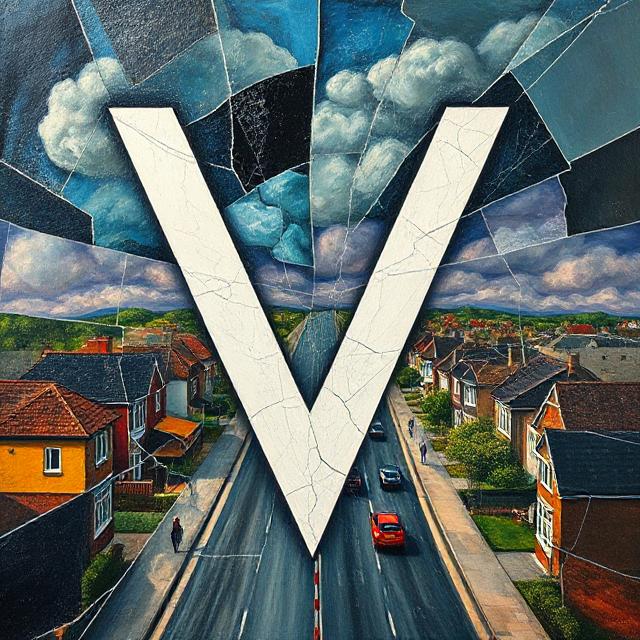
The lamp was everything. It was the entire perspective. Thin cracks ran through it, through the existence, like glass under too much pressure. Sometimes Vesper swore she could see through them. Faces and asphalt tinted in red.
There was nothing outside. No oceans. No mountains. No past. No more cigarettes. Just an edge. Even the city was merely part of buildings remaining here and there.
She had known for months, but today, she and her lab partner finally confirmed it. Existence wasn’t. It never had been.
The calculations were undeniable. The clues were all over.
And after all she should have known. Everything revolved around them, their places, their wills, their friends, their names.
Everything ran on borrowed time, and that time was about to run out. The numbers told her the exact second everything would vanish. He was waking up. The end was written, like an equation waiting to be solved.
She turned to her lab partner, ready to speak, to process it out loud. But she didn’t. Vesper exhaled sharply. It was no longer important to pretend Radimir was still here. He had mattered, and the memory of him did too, but not enough to keep talking to a shadow. She looked away and his cardboard shape vanished.
She had solved it.
Did it matter? If the world was going to end, there was only one question left: Why tell anyone?
Would it change anything? Would knowing make the final moments any better?
No.
So instead, Vesper did something else. Something small. Something human.
She did nothing.
Vesper opened the door of her lab and stepped directly into her brother’s garden. She couldn’t be late for her nephew’s birthday party.
There were balloons. They looked off, like they weren’t really tethered to gravity, but no one else seemed to notice. There was cake. It was too sweet, too red velvet, too Nadir.
And there was laughter.
Today her nephew turned two. He giggled, shrieking with delight as he smacked his hands into the icing, smearing it across his face. The adults laughed with him. Nadir stood by his wife, watching their son with that quiet, exhausted kind of love only parents seemed to have.
Vesper sat down beside them, pressing her hands into the rough fabric of the couch. Real or not, this moment existed. And if everything was about to end, then this moment… The warmth of her brother beside her, the sound of a child’s laughter, the weight of time pressing against her ribs. It was the most important thing in existence.
She breathed in.
Hold it.
Somewhere, deep in the fabric of reality, the final second arrived.
Not silence but chaos erupted. Voices, cars, screams, all kinds of weird noises pierced the veil.
Then —
The world ended.
There was no darkness. No after. No explanation.
Dad woke up.
Here, like there, nothing mattered.
If nothing matters, then we are free to decide what does.
 Soryn Nobody
Leave a comment