


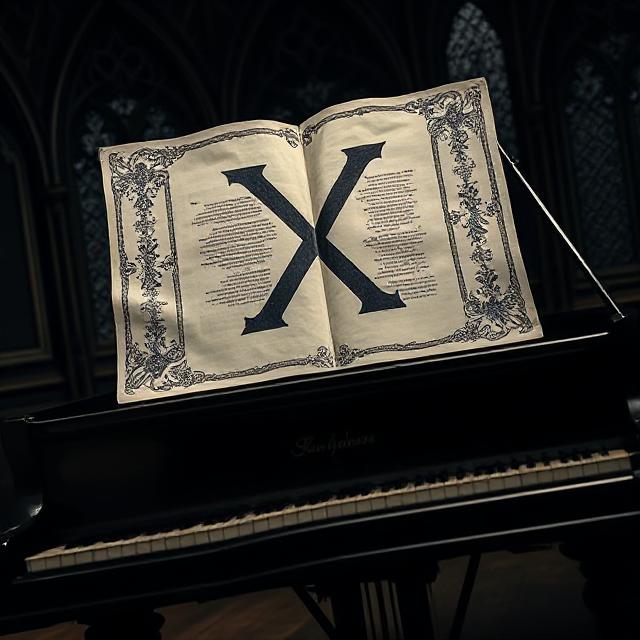
The massive black beast throned in the middle of the room. This grand piano should have been the least odd item in Xavier’s Cabinet of Curiosities, but it refused to be. he Schimmel occupied the middle of the room like a sublime, obsidian-engineered creature lurking. Its polished ebony skin gleams like liquid night, reflecting light in rippling waves, as if the surface were alive and breathing. The lid rises like a raven’s wing, revealing strings that gracefully dance with each stimulation. Its keys, stark ivory and jet, were a sensual battlefield, their smoothness beckoning fingertips to slide in a drunken abandon. Each note possesses an almost hypnotic vibrato, a siren song that reaches deep into the soul, coaxing forth emotions hidden in shadowed corners. It was not an instrument you played with, but one that played you, directing your emotions in alternation between whispers and roars.
Its last note thrilled and faded without ever quite disappearing.
“It’s in place and tuned,” the antiquarian claimed with a long, concluding breath.
“I don’t think the tuning was necessary, but that’s kind of you,” Xavier thanked. “It would have been quite difficult for me to get it here,” he added, pointing to his foot cast.
“Do not worry, it’s part of the adventure of my profession,” she responded behind her tiny round glasses. “Your establishment was easy to find and on the ground floor. In other circumstances, cast or not, we would have needed more help.”
This lady was a professional beyond all Xavier’s expectations. She had the equipment to move such a large piece of furniture, including a small crane. Even without that, she had twice the musculature of Xavier, who was far from being thin. She pushed the piano with care and strength, as if it were weightless.
“Would you like something to drink?” the host inquired.
“If that doesn’t bother you, I’d love a cup of tea.”
“Perfect, I’ll make a pot right away.”
“Do you need help?”
“No, it’s nothing more than a little bit of water and a button to push. I can still do it,” Xavier gently joshed. “Take a seat and you can tell me more about it.”
She chose the antique white Napoleon III chairs. She moved back and forth in it, first because it was a capricious seat, and second, to better sink into her own voluminous and chaotic mane.
Xavier jumped into the adjacent kitchenette and turned the boiler on. He grabbed two cups, two saucers, two spoons, the Chinese teacup, and finally the bag of tea. He adjusted his jacket and leaned against the counter.
“You bought it without knowing?” the antiquarian enquired from the main room, her voice laced with concern.
“Let’s say I heard about it. I was seduced before learning all the stories,” Xavier admitted loudly to keep the conversation going.
“It has a growing reputation, you know?”
“I know, that’s why I chose it.”
The conversation died again, only to be replaced by the boiler finishing its effort.
“Do you think you will play it?” the lady asked, concerned once more.
“Me? No, I’ll be incapable of that,” Xavier responded as he poured the hot water into the teapot.
“That’s sad,” she mumbled.
“What?” her host enquired, more focused on not spilling anything than listening to what had just been said.
“That’s a shame for such a piece,” she repeated louder, with a sigh.
“I thought about organizing a small reception with different players. I met Benjamin Grosvenor thanks to a mutual friend, and he didn’t seem against the idea.”
Likewise, the middle-aged (or old, Xavier wasn’t sure) lady seemed to appreciate the idea. Then she leaned forward, judging the young man behind her opaque glasses. She returned to a more comfortable position and pushed her second pair of eyes back up her nose.
“You are not a believer,” she exclaimed.
“A believer of what? In terms of religion, I’m a proud atheist, even if my father disapproves,” Xavier said, his eyes directed toward the sky.
Back in the main room, he delicately placed the teapot and cups on the oak table. He laid back in his chair, looking around, then added:
“But if you mean a believer in all of this, those superstitious trinkets around the room, no.”
“Nonetheless, you own a Cabinet of Curiosities?” she asked without moving a muscle.
“Exactly! I believe in the power of stories, not in their veracity. Like its story.” Xavier extended his arm so gently his finger slid over the sleeping musical monolith.
“You’re something, that’s for sure.”
“I hope so!” he bragged, amused.
“But eccentricity and temerity could be a disguise for recklessness.”
“Let’s resolve that. I’m listening.”
She strangely didn’t move at all, like a statue. And her hidden eyes made her difficult to read.
Xavier loved people who knew how to enchant their thoughts and stories with this kind of poetry. It was quite inspirational for his own reinterpretations. And a good storyteller should never underestimate a good silence. Nevertheless, the current break in the discussion was uncomfortable.
And if she…
“Can I have some milk with it?” she finally asked, as normally as could be. “And then we could see if you are able to endure its reputation, as you say,” she even joked.
“Surely.”
He hobbled back into the kitchen to grab the milk. She used this time to pour both cups.
He sat.
She slid a cup in front of him and sank back into her hair.
She pushed her glasses up and took a deep breath.
*****
“This beautiful Schimmel hasn’t encountered many homes during its life, but it has still traveled, and not for benevolent reasons. It was cursed from the beginning.
It was built as the last of its series and forgotten in the storage room of the manufacturer. These pieces were custom orders, expensive, renowned, and carefully crafted. But this one never reached its original client. She was a promising young pianist, entangled with a dangerous lover. He was her end. Her parents never found the courage to collect the piano.
It stayed hidden for 40 years before it found its way to my shop, thanks to a private auction in the late 90s. There were doubts about its correct value, so I contacted an expert, Lucian Von Karl. Lucian was a piano technician who had worked for some famous brands before starting his own business. He was a magician, capable of making heavy damage disappear. So, I asked for his advice on the original price.
150,000 pounds. The piano seemed to have enchanted him. He immediately made an offer at his given price. I wasn’t crazy enough to sell it to the person responsible for appraising it. I asked another specialist, who came with a slightly lower price. That confirmed it, and I didn’t hesitate. I sold it to Von Karl.
But I regret it today.
I meant it when I said he seemed enchanted by the instrument. He studied it down to the most discreet detail. Multiple times, he dismantled it carefully, placing each part religiously for inspection. It reached the point where he admitted he could mount and demount it blindfolded, using only the feeling of touch and the sound of each piece’s vibration in the air. He played it too, after all, it was a grand piano. Von Karl played it for hours, even days, according to his wife. The piano howled with strength. He was a good pianist, at least a decent one, enough to entertain an amateur audience. Nevertheless, the technician lacked a certain emotion when he played. He was more conscious of this than anyone else. He was looking for a sound that was just beyond his reach.
Time, that unstoppable force reigning over all of us, was a master Lucian could not escape. Without realizing it, he had overused it. Spending time with the monolithic instrument meant pulling time from somewhere else. He had neglected his business for too long, and money ran out fast. On top of that, his son would soon discover the joy of being a brother. The arrival of a fourth mouth at the table became his trigger to reestablish a more stable relationship with the instrument. Or at least, that’s how it seemed at first. He went back to working even harder, with more talent than before, but above all, with more determination. The emotion he had lacked when playing revealed itself when he was fixing other instruments. They often turned out better than before. And yet, he was not satisfied.
It wasn’t until a glass in the back of a pub that he half-consciously admitted he was trying to recreate the sound of the Schimmel. After a few more drinks, he realized it was a vain quest, though it was still his burden to bear. What he revealed after the last round was not meant to be heard by anyone. It entangled the passion of mind, chair, and music with more than just his wife. He found a form of control over his obsession, and the growing responsibilities of his family became his focus. Soon, his reputation began to grow as well.
As talent calls talent, it blossomed within his own family. From a young age, both of his children took an interest in music and in the family’s grand piano. The eldest, Markus, observed his father play it, even requesting specific songs before going to sleep. He was sometimes surprised by his mother trying to replicate the movements. And after her brother, little Cleo did the same. They both grew to be gifted with the imposing instrument, in different ways. At five, Cleo grasped the basics as quickly as her brother Markus, who was seven at the time. Like his father, he was more scholarly, whereas she was more emotional, intuitive. He didn’t experiment any less, though. After school, he ran to the Schimmel, sat down, and played simple tunes over and over, each time with more care and exploration, in accordance with his knowledge and the other pieces he had seen.
Once, his mother surprised him, tapping the keys softly when he thought no one was around, just to hear the sound, the howling of the beast. Still, her sister was progressing as fast as he was, and that with seemingly a tenth of his effort. He was missing some magic she had managed to release. In reality, they were both found to be gifted, but in different ways. Markus trained, rehearsed, and learned the theory and subtleties of the Schimmel better than his father. He never tried to dismantle the instrument. That was his father’s journey. He was an observer. At eight, he started writing exercises for his sister. At nine, he was already translating opera and classical concertos to adapt them for piano, solo or in ensembles. At ten, he composed his first piece. He hid it for a time, but his sister found it. He never admitted it, but his father knew it was composed for the Schimmel, and not for another instrument. The composition was naïve, an amateur work, but it was not lacking in passion, that was for sure. It revealed subtle qualities of chant that had even escaped Lucian Von Karl himself. The Von Karls encouraged both of their children to pursue the careers for which they were destined.
In reality, Cleo had entered the conservatory before entering primary school. Her brother followed.
She was shining when he had more difficulty building a reputation. He had his father’s ruthlessness in his own work but lacked some vision, as if he was always being dragged towards something else. The fact that he was unable to convey his own work when playing the Schimmel didn’t help. He just missed something. His compositions were truly beautiful pieces, some of which were even later played by some of his father’s clients during private receptions. There, in small committees, his compositional talent was praised, but not by him.
And despite all of that, he wasn’t able to play on the grand piano of his dreams. Every attempt turned into cacophony, transforming his masterpieces into torture from another age, a dark age. Only his sister was allowed to reveal all the true poetry of the instrument. She had a natural connection with it. Something she only shared, something deep, a link beyond the senses. As a baby, “piano” was her first word. Her parents attributed this to the constant evocation of the instrument in their conversations. When she grew older, she started talking to it. Her parents chalked this up to some kind of imaginary friend. Those special treatments for the Grand Piano didn’t diminish as she grew. But as her talent developed, her parents took it as a form of genius eccentricity.
Lucian Von Karl was a gifted technician.
Markus was a gifted composer.
Cleo was a gifted pianist.
But even the gifted can be devoured by desire, probably more than others.
Their mother was gifted with a loving family, as she said. And it’s true that the sister and brother loved each other. Still, Markus was incapable of finding satisfaction in his own talent, and as primordial as it was, he envied his sister’s. He had spent nights in front of the Schimmel, unable to press a single key. Why did it refuse him what it offered so easily to his sister?
As talent and time passed, jealousy grew.
She played just for the family.
Her mother was cooking in the kitchen.
Her father was working in his workshop.
Her brother was silently observing.
He took the piano tuning lever, a large and bulky tool used to adjust the tension of the strings, not that the Schimmel had ever required it.
He broke her fingers still on the keyboard. She didn’t have time to realize he had pulled her down and ravaged her from head to toe.
Their mother, surprised by the impromptu silence, came into the living room.
She screamed.
He silenced her.
Lucian ran into a scene of pure horror. His family in a sea of blood, and only his son standing.
Markus broke his knees, then his skull.
He sat in front of it.
He played.
The audience was silent.
He played like never before, with more passion, more emotion, more of himself.
The black and white keys faded to red, one after the other.
He was composing as he was playing.
He was free.
It refused.
Realization struck him harder than a hammer. Whether it was the horror of what he had done, or the weariness of trying and failing, what struck him still is a mystery. He collected his sheets of music, his creations, his sketches, and climbed to the highest room of the family manor. Such as an angel of paper and silent music, he left the nest.
His body was found in front of the window door leading to the living room, only a panel of glass separating him from the rest of the family.
In silence, the Schimmel remained.”
*****
“That’s a great story, for sure.”
“That’s a true story,” Helena corrected.
“I don’t say they’re not dead, but you, like me, know how to embellish a story.” Xavier retorted, finally sipping his tea.
“I see you don’t believe it yet. It’s normal,” she said, her glasses shining as she looked at the ceiling.
“I told you, I do not believe in ghosts, spirits, or magic.”
“I can see that. But you will change your mind,” she said, sipping her tea for the first time too.
“That kind of rings a bell. I think I read about it years ago, but I didn’t recall any mention of the Schimmel.” The young man grabbed his phone and quickly searched for Von Karl. “Bah, it would make sense in such a family home. I can see the conclusion: Lucian Von Karl was the one responsible, too harsh with his kids. Only an adult could have done that. He was the one who snapped,” he concluded after his quick investigation.
“That’s what people say. It’s easier to think the dad did it. Less scary.”
“I admit, the ominous Grand Schimmel as the unreachable creature, that’s a good story plot.”
His phone still in hand, he used it to keep notes on the story. He wrote the main ideas as bullet points to help him build on them in his own style.
“That’s probably what Madame Lyra thought too.”
“Madame Lyra?” He asked, not looking at the mysterious antiquarian, still taking notes.
“The second buyer I sold the Schimmel to.” She escaped, getting his attention back. And it worked.
“You got the piano back?” He frowned.
“I had contact with the agency that sold the house. And the Schimmel found its way back to my shop for a decent price.”
“Madame?” Xavier let the word float in the air, thinking. “An aristocrat, someone in the military, or a fortune teller?”
“The last one. And probably not a good one because she couldn’t see what was coming.” Helena joked, making her hair vibrate. The joke could have landed, but the tone was slightly off. Xavier smiled to be polite.
“A spirit and a cursed object. That’s an explosive mix. Tell me more.”
“You asked for it, but once more, that’s not entertainment. Those are facts, and above all, warnings!”
“So, warn me,” he replied, more amused than concerned.
He grabbed more milk to put in his not really great tea. Then he settled back comfortably in his chair. His personal storyteller did the same.
*****
“Madame Lyra discovered her talent at an already advanced age, after the death of her husband. Some people think she needed something to entertain herself, while others believe that a life-changing event like that can sometimes reveal what was dormant. Not that she had to work. She offered her services freely. She was discreet and appreciated. Even though the townsfolk were her main customers, people came from far and wide. Her only eccentricity was her clothes. In that regard, she seemed to live in another time. Corsets and hairpins were classics for her. She owned a house in the countryside, a big old house from the last century as well. The inside was quite mundane, but most people couldn’t know that, as they only saw her divination boudoir. It was a little bit cliché, but that was what her customers expected. The Schimmel was just an additional touch in the decoration. Covered with candles and pots of unknown content, it blended well. And like that, it accumulated dust, as she was never seen playing it. She didn’t know how to play, nor did she want to, concerned about its past.
The real stunning object in the room was the large clear crystal ball on the main table. That was her symbol and the detail that stood out, visible even before entering the place thanks to a huge window. Outside of her working hours, she was a normal villager. She went to the local market on Thursdays, attended the school show every summer, and was even a member of the church choir. People found her a little chatty, but they didn’t mind, as she always told truths once the curtains were drawn.
One Tuesday came. Tuesday, as it was always Dona’s consultation day. She was the forever mayor’s wife, proud to be a patron of numerous little businesses in the village and even beyond. The distinguished lady arrived in the late afternoon, as always, when she was greeted by a strange noise. It was unusual. It wasn’t music, nor a melody. It was just one note, a long, unshattered continuous note. The curtains were drawn; Dona couldn’t peek inside to guess the source of this sound. She waited patiently in the entry for a good 30 seconds. Then, as the sound persisted, she knocked on the boudoir’s door. Madame Lyra couldn’t possibly be with another client, as it was Dona’s reserved time. The sound immediately stopped. The door opened to reveal a half-surprised Madame Lyra, putting her hairpin back in place. She apologised and requested two minutes to clean her lunch leftovers. Dona granted that time, quite surprised by this late lunch. The séance went undisturbed after that. But Dona would tell you that from that day, everything changed. From that piano note. And she would always remember that it was a Tuesday, because Tuesday was her consultation day.
It was more common to arrive and find the curtains already drawn. A note could be floating in the air, but it was hard to pin down as it vanished as soon as the customer walked through the front door. Young kids even reported hearing more than one note. They mentioned variations. Two notes at first, then three, then more. With the passing weeks, the unreachable sound was rumored to have extended into a full melody. Whether Madame Lyra was behind it or not became a subject of gossip and debate around the village. But no one confronted her directly.
Still smiling, her once fiery green eyes had become glassy and distant. She began wearing more layers, gloves, scarves, despite the fall being unusually warm for the season. Some of her consultations’ secrets slipped out in strange, confused public mumblings. Her readings were laced with cryptic phrases, even more cryptic than before, such as: “The notes are not mine to play,” “Do not seek in others the melody you have already found in the right one,” or “The hollow will call you home.” Dona, the Mayor, the teacher, the baker’s husband, and even Silvia, the pastor’s young niece, who made a living from her video commentary on the Internet, all left her place with a sense of unease. For some sensitive ones, like Silvia, it was as if something unseen had been watching them from the shadows.
It was in December that Silvia stopped visiting Madame Lyra. For the past month or so, since the first snow, the fortune teller had added a new practice for her most exclusive clients.
Outside of those rare moments, the place was empty of sound. The rumour of the fading melody vanishing once the door opened disappeared, only to be replaced by growing concern about Madame Lyra. She began inviting her clients to play what was in their minds, hearts, and spirits. She claimed to respond to their questions in depth, but only if their melodies were honest. This was initially just an extension of her usual practices, but soon the balance shifted, and it became the main gig. She pushed this new practice as much as her clients did. In reality, her readings through the piano’s melodies became even more accurate than those with her crystal ball.
Then one day, quite suddenly, not on a Tuesday, as Dona learned after speaking to the baker’s husband, Madame Lyra stopped using her piano altogether. Not only did she stop, but she refused to let anyone play it before, during, or after consultations. She claimed that her crystal ball was enough to see into people’s hearts. People disagreed. Even Dona, as the mayor’s wife, tried to reason with Madame Lyra. She was given the choice to stop her lobbying or lose her Tuesdays’ exclusivity. But even without Dona’s influence, people tried, asked, and demanded. Tired of the complaints, Madame Lyra stopped singing at mass. Slowly, she even began avoiding the weekly market. Eventually, she avoided the whole town. But the town didn’t avoid her boudoir.
It was the baker’s husband who drove the final nail into the coffin. He had a nasty dispute with the fortune teller after yet umpteenth piano reading request. He described it as though Madame Lyra had turned into a demon, with blood seeping through her gloves. She cursed the brave man, kicked him out, and slammed the door. Rumours spread fast when it confirmed what people think or want to hear. Madame Lyra, once a respected member of the community, turned into the cuckoo witch at the end of the road. People finally avoided her boudoir, just as she had been avoiding them.
Then spring came. Madame Lyra’s reputation still lingered in people’s minds, but she was no longer the centre of discussion. Indeed, it was said that the baker was working with more than one oven. While the town was busy discussing which bread was cooking in which oven, the young postman was trying to put letters into the mailbox. He noticed not a sound, but a smell. For a long time, Madame Lyra’s shop had been closed, her curtains drawn. As the days passed, the smell grew from unsettling to unbearable, prompting him to call the authorities.
Two unfortunate female officers forced their way in. In the house, everything was dormant. In the boudoir, it waited. Everything had been pushed aside, except for the piano, which loomed like a dark monolith, its keys stained crimson. Madame Lyra’s body was found seated before it, her back arched unnaturally, as though mid-play. But it was her chest that drew their horrified gaze. Where her heart should have been was her crystal ball, its once-clear surface now swirling with an inky, viscous fog and veins. Her ribs arched outward like the prongs of a grotesque crown, framing the ball as though her body had been twisted to accommodate its presence.
Her hands were fused to the piano keys, her fingers twisted and elongated like pale, fleshy roots merging with the instrument. When the authorities attempted to remove her, the piano emitted a low, resonant note that rattled the room, sending one officer screaming into the street, babbling about “the return of the unreachable choir.”
Worse still, the crystal ball began to pulse, faintly at first, then with a rhythm unmistakably resembling a heartbeat. Then, from the piano, came a sound. Soft and chilling, a single note escaped, followed by a voice, low and gravelly, as she whispered, “Listen to your future.”
The remaining officer fled the house, locking the door behind them. The town tried to forget, but at night, faint melodies drifted on the wind, accompanied by whispers in a language no one could comprehend. Some say the piano still plays itself, calling to those who cannot resist the allure of its haunting song.
The house, like the piano, was sold, but the melody never left.”
*****
Helena looked at Xavier, who was still somewhere else. He snapped back to reality and nervously grabbed his phone, quickly jotting down notes.
“It’s an amazing tale about small-village peer pressure and obsession,” he managed to blurt out, breaking the lingering silence.
“No, it’s simpler than that. It was jealousy.”
“Jealousy? From the people?” he guessed, studying her face. But her gaze, hidden behind her glasses, was fixed on the Schimmel, not directly, but as if she were avoiding it.
“Oh, I see. You almost had me there. But I’m not really seeing that in this story.”
“That’s not a tale. That…”
“A true story,” he interrupted abruptly. “Sorry, I… I’ve had a long day. I think I’m starting to get tired.”
“Maybe you should rest.”
“Nah, let’s finish this so you’ll be free,” he joked.
She smirked.
“You still doubt, even with proof? You can look it up on your phone. You’ll find plenty of townsfolk’s testimonies about the events,” she challenged him.
“I can imagine that people thought they saw what they did. But there’s always an explanation.”
He took a few seconds to come up with one.
“Maybe it was mass hysteria, or some kind of hallucination. Like ergot poisoning from contaminated grain? That’s happened throughout history.”
“But that was less than ten years ago,” she countered. “I think we’re better at detecting that kind of thing than they were in the Middle Ages, don’t you?”
“Let’s say it’s true. Still, her fingers couldn’t have fused with the keys. Its keys are immaculate.”
“Thanks to the work of a technician. One, I refused to sell the Schimmel to, this time,” she said, pouting slightly, as if recalling something exhausting or costly.
“You got it back again?”
“Yes, or it wouldn’t be here today. I can’t keep it, and I don’t want to, but it always finds its way back.”
“You seem to have your own stories,” he noted, then shook his head. “But let’s finish with the Schimmel. I read about its last owner.”
“You read a version of the last story.”
“I’ll admit I don’t know much. I learned it somehow survived an arson attempt, a failed insurance scam. But that’s about it.”
“I can tell you more.”
He hesitated, then slowly placed his phone down on the low table. He leaned back in his chair, shifting uncomfortably, unable to find the relaxed posture he had earlier. He glanced over his shoulder at the black monolith looming behind him, as if making sure it hadn’t moved. A childhood reflex, resurfacing.
He exhaled and smirked at it, amused.
But when he turned back to the antiquarian, something unsettled him. Her presence felt… off. She hadn’t moved. In fact, he had the eerie sensation that she hadn’t moved at all, not a muscle, not a hair, since she’d finished her last story. No, she had made expressions. Hadn’t she?
“Are you ready for the next owner’s incident?” she asked.
But she didn’t wait for a reply.
*****
“Jack Turner was the proud owner of Crescendo’s, an old, dimly lit music bar he had managed for roughly a decade. It was one of those places with a stellar reputation yet still maintained a sense of freedom and an easy-going vibe, making it a welcoming space for amateurs to begin their journey. On top of that, Jack had eclectic musical tastes, hosting artists from classical to urban rap, including improvised jazz, experimental phonk, metal, K-pop, and even mainstream pop music. Many patrons first visited Crescendo’s for a particular artist but returned for something completely different, or for an open mic night.
Jack had a keen sense for discovering promising new talent. That was the case with Elise. She was a friend of a friend who, over time, became a regular and eventually, a friend herself. She was a music history student in her final year, uncertain about the future. Passionate about her work yet shy about her talent, it took months to convince her to perform. The fact that Crescendo’s didn’t have its own piano didn’t help. It was her instrument of choice, and she couldn’t afford to take such a financial risk as buying her own.
They came to an agreement: Jack would buy a piano for Crescendo’s, and she would be the one to inaugurate it.
Elise, initially reluctant, revealed she already had a piece in mind. She was captivated by a forgotten composition by a child prodigy from the early 2000s. All Jack had to do was find a piano. But even though Crescendo’s was doing well, a good piano was an expensive investment, and on top of that, Jack was exacting. His search eventually led him to my shop. He found exactly what he was looking for. More than he had bargained for.
Between its restorations and its growing reputation, the Schimmel had become a pricy instrument, but no one could deny its presence. Jack admired it without touching it. He returned three days in a row.
The first day, he stayed for an hour without saying a word.
The second day, he asked about delivery, pricing, and standard questions about grand pianos.
I tried to warn him.
By then, I had started noticing the pattern with previous owners. Once is a coincidence. Twice is suspicious. But Jack wasn’t a believer.
On the third day, he returned with Elise.
She introduced herself through timid arpeggios, then moved into well-executed but rigid classical pieces. She was a decent player, but there was something restrained in her performance. I assumed it was my own unease about selling the piano clouding my judgment. But when she looked at Jack, then at me, there was a light in her eyes, the devotion of someone discovering a door to freedom.
She convinced us on the spot. Jack bought it that day.
I should have been more resistant. No, I should have been more resistant.
The Schimmel took its place at the back of Crescendo’s main stage, standing just beyond the reach of curious hands, guarded by theatrical red ropes. It watched and was watched in return. It waited.
Jack gave Elise a week of after-hours practice before the grand opening. She practiced with determination but still carried that same restraint. Jack didn’t notice it, but she still hadn’t managed to get her hands on the piece she had been searching for. Yet she remained resolute, convinced it would be perfect for her debut.
What Jack did notice was that she was underperforming, incapable of fully letting go.
The night before the opening, they had a talk. That’s when he learned the truth: she was still looking for the piece. With time running out, they scrambled for alternatives. Or rather, Jack did. Elise remained unconvinced.
Opening night arrived.
Curious newcomers and familiar regulars had gathered well before Elise’s scheduled time. She wasn’t the biggest name of the evening, but she was the opening act.
Not seeing her anywhere stressed Jack more than the rush of managing the event.
Fortunately for his heart, she arrived just in time.
Dressed in black from head to toe, in a sharply tailored suit, she looked stunning.
She smiled with satisfaction, a note of defiance glinting in her eyes. Across the room, she tapped on a booklet of sheet music.
Jack’s eyes widened, a mix of surprise and admiration flashing across his face. Then, just as quickly, his expression shifted to something more urgent. He nudged, an unspoken order for her to run onto the stage. He was too occupied to escort her or announce her performance, but that was a minor detail.
The first notes were timid, not out of shyness, but as a deliberate, intriguing softness. Something had changed. Not just in Elise’s playing, but in the very tone of the Schimmel.
The piece began with simple arpeggios, reminiscent of early learning exercises, yet touched with subtle variations in volume and nuance. Jack finally exhaled as he noticed the patrons settling in, beginning to enjoy the performance. The minimalist variations soon transitioned into something more unrestrained, on the edge of free jazz, yet laced with classical precision.
The once discreet notes evolved into an entrancing, eerie melody, demanding to be heard.
The patrons’ attention was captured. Conversations quieted. Drink orders slowed.
The Grand Piano expressed itself in a form wilder, more primal, freer.
Jack snapped to attention as a perfectly in-tone dissonance jolted him awake. He scanned the room and found every eye fixed on Elise.
Then, the first fault in the performance emerged. It was not in the music itself, but in the audience. A low hum arose, deep and unbidden, as some patrons unconsciously joined in. One by one, their voices layered into the melody, at first subtle, then growing louder.
Moans.
Then screams.
And yet, disturbingly, none of them overpowered the music. They complemented it, as if their wailing were meant to underline the melody rather than disrupt it.
Jack, now uneasy, approached the nearest patron, a man of uncertain age, hoping to stop the revolt before it grew too much. But the moment Jack placed a hand on his shoulder, the man convulsed violently. His arm slammed against the bar, his body writhing in seizure-like spasms. Then, just as suddenly, the grotesque shaking ceased. His movements became controlled by something else.
Like a marionette, he began to sing.
Horribly. Loudly. Yet, somehow, still in sync with the Schimmel’s theme.
Others turned to him in shock. A few seconds passed before they too began to hum. One after another, more patrons joined in. And then, just as Jack realized something far worse was happening, they convulsed as well.
A cacophony of bodies struck the walls, the floor, and each other.
For a fleeting moment, the music faltered for just a heartbeat’s pause.
Then the movements synchronized.
The chorus, once disjointed, fused into a single, guttural moan of adoration.
Their eyes, every last one of them, turned a sickly, glowing green. They swayed lifelessly, gazing at Elise as if she were some kind of divine conductor.
A few uncorrupted patrons tried to flee.
Resistance was futile.
The others turned them, forcefully, violently, until their voices, too, melted into the chorus. Their cries of terror faded into acceptance.
And with their devotion, the melody swelled.
Elise played faster than ever. Her head was bowed, her face obscured by a curtain of dark hair. She seemed utterly consumed by the performance.
The piano, in turn, responded.
The dark wood of the Schimmel began to twist, warping unnaturally. It expanded outward, wrapping around the stage like creeping vines. The shadows it cast were no longer merely shadows. They devoured light itself, swallowing Elise until she was nothing more than a silhouette among them.
A single shift in the melody sent a shudder through the crowd.
The dissonant choir harmonized.
And as the darkness engulfed them, Jack could no longer see the patrons as people.
They had become vessels.
He staggered toward the back door, his breath coming in short gasps. His mind screamed for escape.
But his movement did not go unnoticed.
Jack stopped dead.
A lost soul mumbled incoherently in the corridor ahead. He hesitated, inching backward, trying to make himself as small as possible. Then he saw their eyes, green, vacant, wrong.
They turned.
Maybe he hadn’t been as silent as he’d hoped. Maybe it was just bad luck.
His pulse pounded as he slipped into the storeroom and slammed the door shut. His hands trembled as he pressed against it, holding it closed with all his strength. The metal handle bit into his palm, but he couldn’t let go.
The growling outside had spread through the entire building. Even the walls seemed to hum with the melody, vibrating in unnatural harmony.
Jack’s breath hitched. The lock.
He reached for it with his free hand, twisting it as fast as he could, wincing at the faint click.
Footsteps.
Approaching fast.
Jack stepped back, his body coiled like a spring, ready to throw a punch at whoever, or whatever, came through. Through the crack in the door, he saw their shadows swaying erratically. Their steps were heavy, weighted, unnatural. They shambled past, ignoring the door entirely.
More followed.
A broken parade of patrons, their movements jerky, marionette-like, only some were quicker, more urgent.
Jack exhaled slowly and took another step back.
His foot hit something.
A box. It had always been there. But beyond it, in the farthest corner of the storeroom. Someone.
A woman.
Curled up, face buried in her knees. Silently sobbing.
Jack tensed. His fingers wrapped around the neck of a glass bottle, ready to defend himself against whatever this was.
Then he saw her suit.
Elise.
His breath caught in his throat.
She looked up, mascara streaking her cheeks, eyes raw from crying. Before he could react, she threw herself at him.
Jack stiffened, arms frozen in the air as she clung to him, shaking.
She mumbled broken fragments of an explanation, something about how she couldn’t do it, how she wasn’t meant for this, how she had arrived and seen herself.
None of it made sense.
Jack tried to piece together her words, but she kept circling back, cutting herself off, repeating the same things.
She was unraveling.
Carefully, he lowered his arms around her, pulling her into a firm, steady embrace. Just tight enough to make her breathe.
She sobbed harder, no longer trying to explain.
When she finally calmed, he cupped her face gently and asked for clarity. They had no time to waste.
“How did you end up here? How are you safe? You were in the middle of all of that.”
Elise blinked at him, disoriented, as if she hadn’t even realized what had happened to the patrons outside.
“I… I got here late,” she murmured. “I had nothing. No music. I was… I was ready to just let it all fall apart. And then I saw myself. Sitting at the Schimmel.”
Jack’s stomach twisted.
“Not me,” she corrected, shaking her head. “Not someone else either. It was something else.”
Her breath hitched as she forced herself to continue.
“The first note, it hit me. Like a punch to the chest. I don’t even know if I actually fell or if it just felt that way, but suddenly, I was on the floor. I crawled away, trying not to let them see me. The patrons, they…” Her voice wavered. “I don’t even remember how I got here.”
She stared at Jack now, truly seeing him for the first time.
Then she heard the melody.
It was still playing.
Her wide, terrified eyes locked onto his.
Jack didn’t have time to explain everything. He kept it simple.
“Stay calm. Stay close. We need to get out of here.”
He left out the worst of it.
For now.
But one thing was clear: They had to avoid the other patrons at all costs.
Jack strained his ears, listening for any movement beyond the door. Nothing.
Just the music.
It filled every inch of the bar, worming its way into his skull, pulsing like a second heartbeat. He clenched his jaw and forced himself to focus. Elise did the same, exchanging a glance with him before nodding. It was now or never.
They slipped into the corridor. Empty, hopefully.
The emergency exit was at the end of another stretch of hallway, just out of sight. So close. Too far.
They pressed against the wall before the turn. Jack’s breath was steady, controlled. Elise’s, less so. And then, she started humming.
His heart stopped.
Before she could even register it herself, Jack clamped a hand over her mouth. His other hand shot up in a silent plea. Stop. Please, stop.
She stiffened, eyes wide with realization.
Just ahead, one of them stood facing the wall. It swayed slightly, humming in harmony with the cursed melody. Elise took a deep breath, her body trembling beneath Jack’s grip.
They started moving.
Slow. Careful. Flattening themselves against the wall, they slipped past the possessed patron. If they could just make it…
A crash.
Elise had stumbled into a painting. The frame banged loudly against the wall.
The patron’s head snapped toward them.
Jack turned, grabbing Elise’s hand and pulling. A blur of motion. Clawed fingers slashing through the air. Elise barely ducked in time. The creature’s nails sliced through strands of her hair.
They ran.
The corridor in front of the storeroom was no longer empty. Five, no, more, lumbering figures blocked their path.
Jack spun.
Even more of them poured in from the other side. Ten, at least.
The escape door was cut off.
Only one way left.
Jack shoved Elise toward the service stairs. She didn’t hesitate. He turned just long enough to kick the closest patron square in the face before scrambling after her.
A guttural growl followed them up the steps. Deep, musical, inhuman.
They burst onto the upper level of the bar.
The dim lighting and thick, smoky air made it hard to see. It was a narrow balcony overlooking the stage, usually reserved for VIPs, with heavy curtains separating private tables.
Three possessed patrons stood between them and the way forward.
And behind them, the creatures were coming.
Jack’s gaze flicked downward. Below the crowd was still dense and dancing. They swayed in trance-like unison, bodies moving in eerie harmony. At the piano, the strange figure continued to play, lips curled into a sickening, knowing smile.
Elise faltered, staring at the pianist. Jack shoved past her, forcing her to look away.
“Focus,” he growled.
No time to think.
Jack grabbed a chair and swung. The nearest patron took the hit full force. They, and the chair, shattered. A leg broke free in each of Jack’s hands, makeshift weapons.
A woman lunged. He dodged, but stumbled against a sideboard. Use it.
With a surge of adrenaline, he shoved it. The heavy furniture crashed into the stairwell entrance, pinning the door shut just as their pursuers reached it.
It wouldn’t hold for long.
Elise had grabbed another patron’s legs and hauled them over the guardrail. The possessed figure plummeted, crashing onto the dance floor below. The crowd barely reacted.
The last patron lunged at Jack.
He struck first, jabbing the chair leg into the attacker’s arm. The patron barely flinched, then seized Jack’s other arm, squeezing hard enough to crush bone. Jack dropped one of the wooden legs with a pained hiss.
No hesitation.
With his free hand, he swung again, full force. The wood connected with a sickening crack.
The patron howled, arm snapping at an unnatural angle. Jack seized the opening. He swept the legs out from under them and slammed the final blow into their skull.
Panting, Jack straightened, scanning the balcony.
Elise was still standing. The stairway was still blocked. But the walls seemed to vibrate with the song below, and that thing at the piano…
They weren’t safe yet.
Not even close.
Behind him, Elise clutched her head, swaying unsteadily.
Jack turned, scanning her for injuries. No blood had been drawn, but something was wrong. Her steps were irregular, heavy, like her legs had suddenly turned to lead.
Then her eyes flashed, an unnatural, despairing green.
“I can’t… stop it,” she whispered, trembling.
Jack reached for her, but Elise twitched. A shudder ran through her, her body jerking as if caught between agony and something far worse.
Then she lunged.
Jack barely had time to react. Her face was a twisted mask of pain and ecstasy, her limbs moving with an unnatural force. She crashed into him, knocking them both to the floor.
He seized her wrists, pinning her down.
“Elise! Fight it!”
She headbutted him.
Pain exploded in his skull. His nose crunched, blood gushing hot down his face. He rolled aside, pushing her off just in time.
They scrambled to their feet.
Elise moved first. She jumped at him again, wild, relentless.
Jack dodged.
She stumbled into the heavy velvet curtains. Jack jumped on the opportunity.
He lunged, wrapping the thick fabric around her, twisting it tight. Elise screamed. She thrashed and clawed at the folds, but he grabbed one of the large ropes and cinched it around her.
The knot held.
Her struggles didn’t stop, but they changed. At first, her shrieks were targeted with rage, desperation, her voice raw with fury. Then, slowly, painfully…
They blended into the melody.
Jack staggered back, gasping. Sweat poured down his face, mixing with the blood streaked across his cheek. His heartbeat slammed in his chest, a hammering pulse reverberating in his skull.
But he couldn’t hear it.
Only the music.
He turned toward the stage below.
A black mass of writhing bodies swayed as one. Dozens of grotesque figures, their luminous green eyes locked onto the piano. The pianist sat at the grand Schimmel, lost in the shadows, hands gliding over the keys in a feverish, otherworldly rhythm. The melody consumed the room.
Jack forced himself to breathe.
Behind him, Elise still fought, trapped in the thick folds of the curtain. He couldn’t think about that now. He couldn’t think at all.
Just act.
He reached for the side bar, hand closing around a bottle of whiskey. His fingers trembled as he patted his jacket pocket. The small cardboard box was still there, the pack of matches he had bought earlier.
For the bar.
For his usual end-of-night smoke.
Funny. He’d always figured booze or cigarettes would be the death of him.
Maybe it was time to let both have a shot.
Jack descended the main stairs, stepping onto the bar floor.
The other Elise had never stopped playing.
The crowd, without looking at him, parted, forming a narrow path straight to the stage. A wordless invitation. Or a demand.
Jack moved carefully, alert, avoiding even the slightest accidental touch. He reached the grand piano, where the dim lights seemed to hesitate, swallowed by the darkness pulsing from the music.
No one waited for him.
The glowing green eyes, gone. The disturbing smile, only a lingering impression, a ghost of something that had never been human.
The Schimmel was playing itself.
Jack exhaled, gripping the whiskey bottle. He uncapped it and poured, letting the alcohol flow freely, over the floor, over the motionless patrons, over the piano itself. The scent of liquor thickened in the air, mixing with sweat and something unnatural.
Dozens of blank faces turned toward him.
He reached into his pocket, pulled out the matchbox, and struck a match.
And let it fall.
Fire erupted instantly. The flames raced hungrily, devouring the floor, the shadows, the Schimmel.
But the music fought back.
The melody swelled, louder, angrier, a raw, defiant wail against the inferno.
The creatures screamed as one. The sound was not pain, not fear. Resonated something deeper, more primal, as the fire consumed them.
The room became a storm of heat and sound. Hell made manifest.
Jack wasn’t here to stay.
He had one plan: to run!
He jumped from the stage, sprinting straight for the front door, shoving, punching anything too slow to stop him. The fire roared behind him, green-tinged and insatiable.
He crashed into the exit.
Locked.
His hands patted frantically over his jacket. The key. He had it. He knew he had it.
Then he heard it.
Tap, tap, tappy, tap.
His fingers betrayed him. It was the rhythms, the melody.
His breath hitched.
He had the key. It was in his palm. The keyhole, mere centimetres away. Millimetres.
And then…
He dropped it.
His knees buckled.
Slowly, he sank down, back pressed against the locked door.
The flames reached the Schimmel, the wood crackling, the inferno dancing to the still-playing melody. The fire licked over the keys, and the music did not die.
A muffled cry rang out, from Elise.
Then, one by one, the patrons collapsed.
Jack exhaled.
With the last shred of defiance left in him, he let out a single, out-of-tune note. A broken, human sound.
His final breath.
The inferno spread, consuming alcohol, flyers, sheet music, chairs, tables, fabric, wood and… bodies.
Then when the last ember settled, when the final particle of ash drifted to the ground…
The Schimmel concluded.”
*****
Like in the story, the silence dropped, heavy. Xavier, his throat tightening painfully.
He didn’t dare turn around. He could feel it behind him. Observing.
“Take it back! Now!” he wanted to scream. Instead, the words barely escaped as a broken whisper.
“I will.” The woman across from him spoke calmly, unfazed. “But I can’t right now. I just need to wait a little.”
“Not everyone died in… the fire. I read… they were survivors.”
He was losing control, not just from the stories, not just from fear. Something else was taking over, something numbing, something wrong. A strange taste spread in his mouth, bitter almonds coating his tongue.
“Yes,” the antiquarian admitted, setting down her empty teacup. “I made some mistakes.”
But Xavier could barely hear her now. His vision blurred, her figure dissolving into a foggy silhouette.
“What… are you… saying…?”
She stood. A slow, deliberate movement.
“That it’s not important,” she said. “That’s part of stories beauty”
She stopped. Then, kneeling in front of him, she leaned in. Her glasses caught the dim light, masking the cunning behind them.
Xavier forced his lips to move. His final question.
“Why?”
She smiled.
Leaning closer, she whispered in his ear:
“Because it’s so simple, it’s cruel.”
A pause.
“Because a good story adds value.”
A shadow flickered across her lenses.
“And yours is still left to be written.”
 Soryn Nobody
Leave a comment